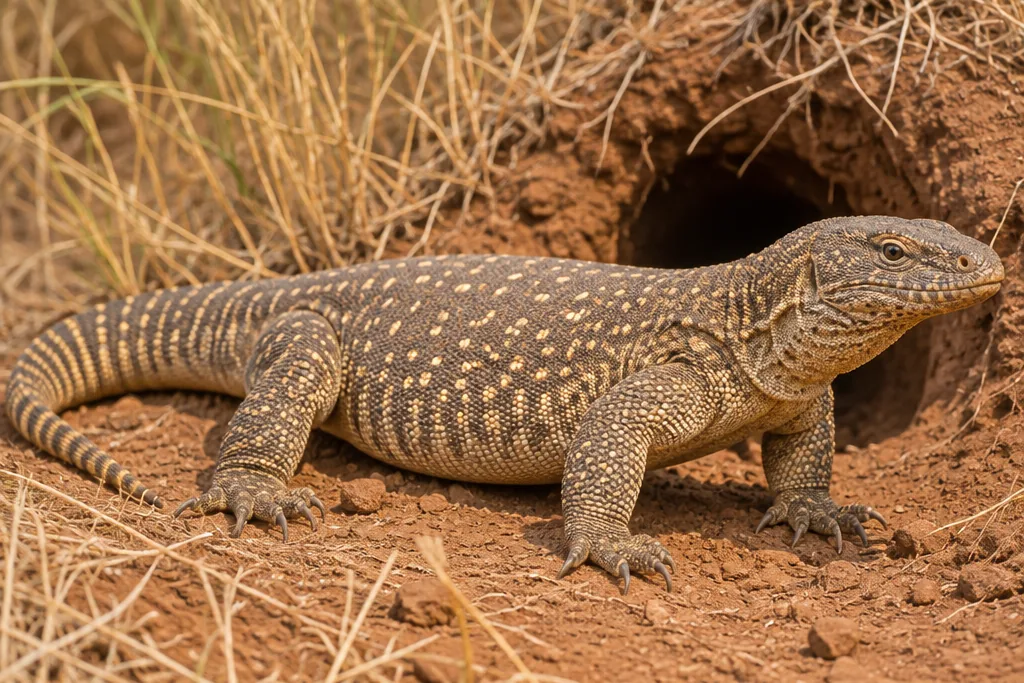
About the Bosc monitor
The Bosc monitor (Varanus exanthematicus), also called the savannah monitor, comes from the grasslands and dry woodland of West and Central Africa, from Senegal east to Sudan. Almost all the animals in the pet trade are exported from Ghana, Togo and Benin. Many are labelled "captive-farmed", which usually means the eggs were dug up from wild nests and hatched on a farm. True captive-bred Boscs are uncommon.
It's a thick-set, short-snouted monitor with a broad head, a fat neck and a relatively short tail. Adults are usually grey-brown to tan with rows of pale yellowish spots. Most reach 75–100 cm (2.5–3.5 ft) in total length, and big males can be very heavy for their length.
Boscs have a bad reputation for dying young, and keepers who study them agree that most of the blame lies with old care sheets. The three big mistakes are a dry enclosure with shallow substrate, a basking spot that isn't hot enough, and a diet built on mice. In the wild, Boscs spend much of their lives in humid burrows and eat mainly invertebrates: beetles, millipedes, snails, grasshoppers and termites. Get those three things right and a Bosc can live well past ten years.
All monitors are listed on CITES Appendix II, so legal trade needs export paperwork. Some countries and states also require a licence for large lizards. Check the rules where you live, and keep the paperwork that comes with your animal.
Housing
An adult Bosc needs an enclosure of at least 240×120×120 cm (8×4×4 ft), and many experienced keepers go bigger or build a room-sized pen. Commercial 6×2×2 ft vivariums are too small for an adult. Use a solid-sided, sealed enclosure (wood with a waterproof coating, or PVC panels) so it can hold several hundred litres of damp soil without rotting or leaking. Glass fish tanks don't hold heat or humidity well and can't take the weight of deep soil.
Hatchlings and small juveniles feel safer in something smaller, around 120×60×60 cm (4×2×2 ft), but they grow quickly and usually need the adult enclosure within their first year. Provide several hides that the monitor can fully fit inside, flat rocks or paving slabs to bask on, cork logs, leaf litter and a large water tub for soaking. A cat litter tray or mixing tub works well for adults.
Substrate and burrows
This is where most Bosc setups fail. Boscs need to dig, and the burrows they make are where they rehydrate and feel safe. Aim for at least 30 cm (12 in) of substrate and ideally 45–60 cm (18–24 in) for adults. A mix of roughly 60% plain topsoil (no fertiliser) and 40% washed play sand holds a burrow shape well. Some keepers add a little peat or coir to hold moisture.
Keep the lower layers damp by pouring water into the substrate, especially at the cool end, while the surface can stay drier. Pack it down firmly as you fill so tunnels don't collapse. Spot-clean waste daily and replace the substrate completely every few months.
Heating
Monitors digest food and fight infection by getting very hot. For an adult Bosc, aim for a basking surface of around 60–65°C (140–150°F) at the hottest point, measured with an infrared thermometer, with cooler surfaces nearby so it can choose its temperature. Juveniles often prefer a slightly lower basking surface. A raised stack of paving slabs or a "retes stack" (slabs separated by spacers) gives a hot top surface and warm crevices underneath.
Use a row of three or four 50–75 W halogen flood bulbs over a basking area big enough to warm the whole body. One very hot bulb tends to heat only part of the lizard. The air near the basking area should reach about 32–38°C (90–100°F), and the cool end about 24–29°C (75–85°F). Turn the heat off at night unless the room drops below about 20°C (68°F). Put every bulb behind a guard and on a thermostat or dimmer, because adult Boscs press against bulbs and can burn themselves.
Lighting
Boscs are active by day and come from an area with very strong sunlight. Provide UVB from a full-length T5 HO tube, such as an Arcadia 12% or ReptiSun 10.0, mounted so the basking surface is roughly 35–40 cm (14–16 in) below it. Run the lights for 12–14 hours a day, and add a bright 6500K LED panel so the enclosure is properly lit.
Humidity
Air humidity of about 50–70% suits most enclosures, with much higher humidity (80% or more) down in the burrows. A Bosc that can't escape dry air dehydrates slowly, which stresses the kidneys and causes poor sheds. Check burrow humidity with a probe hygrometer pushed into a tunnel, and raise it by watering the substrate rather than spraying the air constantly.
Feeding
Boscs are mainly insect-eaters. Feed a varied mix of insects and other invertebrates: dubia or other roaches, locusts, crickets, superworms, hornworms, silkworms and snails. Captive-bred land snails (never garden snails, which can carry parasites and pesticides) are a favourite and close to the wild diet.
Juveniles can eat as many insects as they'll take every day. Adults usually eat several times a week, and the amount should follow body condition: a healthy adult has a visible hip outline and doesn't have fat bulging at the base of the tail. Rodents, chicks and eggs should be occasional treats only. Diets built on mice are the main cause of obesity and fatty liver disease, which are the commonest killers of captive Boscs. Dust insects with a calcium supplement. Some adults naturally eat less for a few months of the year.
Handling
Young Boscs are often defensive. They puff up, hiss, whip their tails and bite. Most calm down a lot with a good setup and patience. Start by feeding with long tongs so the monitor learns that your hand means food, and give short, calm handling sessions once it is approaching you. Pick it up by scooping from the side and underneath, supporting the body and feet, and never grab it from above. Large adults are too heavy to hold for long, so many keepers favour supervised free-roam time instead.
Sexing
Bosc monitors are hard to sex by eye. Males tend to have broader heads and thicker tail bases, and may show hemipenal bulges, but the only reliable methods are probing, ultrasound or X-ray by an experienced vet.
Breeding
Boscs are rarely bred in captivity, which is why the trade still depends on exports. Females that are bred lay large clutches, often 20 or more eggs, in a deep, damp nesting area, and incubation takes around five to six months. Breeding needs a very large, well-run setup and an experienced keeper.
Common health problems
Most Bosc health problems come from husbandry. Obesity and fatty liver come from rodent-heavy diets and low temperatures. Dehydration and kidney problems come from dry enclosures with no humid burrows. Metabolic bone disease comes from missing UVB or calcium, and burns from unguarded bulbs. Newly imported animals often carry internal parasites, so book a faecal test with a reptile vet soon after you buy. A healthy Bosc is alert and curious, digs, basks for long periods and has a firm, muscular body.
FAQ
How big do Bosc monitors get? Most adults reach 75–100 cm (2.5–3.5 ft) including the tail. They are very heavy-bodied for their length, and a few large males grow longer.
What do Bosc monitors eat? Mainly insects and other invertebrates, such as roaches, locusts, crickets, worms and captive-bred snails. Rodents should be an occasional treat, because rodent-heavy diets cause obesity and fatty liver disease.
Are Bosc monitors good for beginners? Not really. They're cheap to buy but need an 8×4×4 ft enclosure, very deep damp substrate, a 140–150°F basking surface and a lot of insects. They suit keepers who have already kept large lizards.