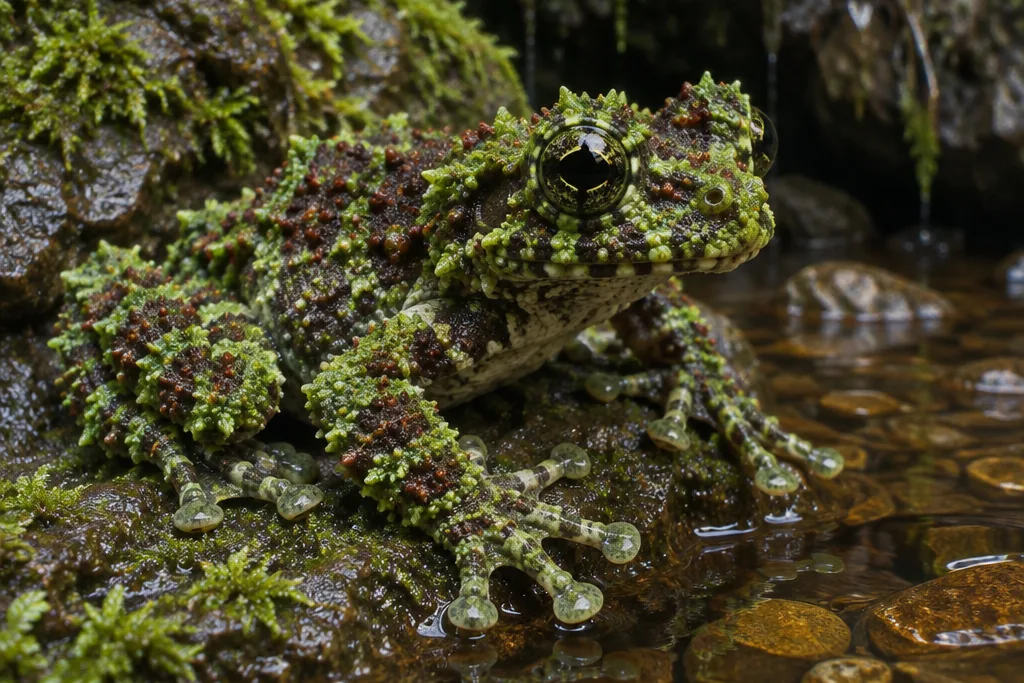
About the Vietnamese mossy frog
The Vietnamese mossy frog (Theloderma corticale), also called the Tonkin bug-eyed frog, comes from the limestone mountains of northern Vietnam. It lives in flooded caves, rock crevices and the banks of mountain streams, where the air and water stay cool all year. It's a semi-aquatic tree frog that spends much of its time sitting in water with just its eyes showing.
Its skin is covered in bumps and ridges in mottled green, brown and rusty red that look exactly like a patch of moss on a rock. When frightened, it pulls its legs in, rolls into a ball and plays dead, so the camouflage does the rest. Females grow to about 8–9 cm (3.5 in) and males are noticeably smaller and slimmer.
Almost all mossy frogs sold today are captive-bred, and they adapt very well to captivity. They're quiet, calm, can live in small groups and often live well over ten years. They're a good choice for someone new to frogs, provided the enclosure can be kept cool. In hot climates, or anywhere summer room temperatures go above about 26°C (79°F), they need a cool room or cooling equipment.
Housing
Mossy frogs need a paludarium: a glass enclosure with a large water area and some land. A front-opening terrarium of about 45×45×45 cm (18×18×18 in) suits one or two adults, and you can allow roughly 40 litres (10 US gallons) of space per frog when housing a group. A 60×45×45 cm (24×18×18 in) enclosure comfortably holds three or four.
Make about half the floor water, 5–10 cm (2–4 in) deep, with gently sloping ramps or floating cork so the frogs can climb out easily. The rest can be a raised land area of planted substrate, cork tubes and cork flats leaning over the water. Mossy frogs like to sit in cork tubes and on bark just above the waterline, and females lay their eggs there. Hardy plants such as pothos, peace lily, ferns and floating plants like water lettuce cope well with the damp, cool conditions.
Water and water quality
Amphibians absorb chemicals through their skin, so water quality is the most important part of their care. Use dechlorinated tap water or reverse-osmosis (RO) water with minerals added back. Never use untreated tap water or any cleaning chemicals in or near the enclosure.
Many experienced keepers add tannins with Indian almond (catappa) leaves or oak leaves, which lower the pH slightly and give the water a tea colour like a forest stream. Change a large part of the water regularly: every week or two in a small, unfiltered setup, or less often with a gentle sponge filter. Remove uneaten insects and drowned crickets as you go.
Temperature
This species comes from cool mountain caves, and heat is what kills captive mossy frogs. Keep the enclosure at about 18–24°C (65–75°F). Night drops to around 15°C (59°F) are fine and even healthy. Don't let it go above 27°C (80°F). Above that, the frogs become stressed quickly and can die.
No heat lamp or heat mat is needed in a normal home. In summer, keep the enclosure in the coolest room, away from windows, and watch the thermometer closely. A misting system using cool water, a small fan for airflow or a frozen bottle of water near the enclosure can help on hot days. Air-conditioning is the most reliable fix in hot climates.
Lighting
Mossy frogs are nocturnal and don't need a basking light. A low-heat LED plant light keeps live plants healthy and lets you see the frogs, on a 12-hour day. Low-level UVB from a weak tube (such as a 2–6% ShadeDweller-type) is optional but used by many keepers, as long as the frogs can sit in shade. Avoid any bulb that adds heat.
Humidity
The large water area keeps humidity high on its own. Aim for about 70–90%, and never let it drop below 60%. Mist the land area and plants every day or two with dechlorinated water. Leave some ventilation, such as a mesh section on the lid, so the air doesn't go stale.
Feeding
Mossy frogs eat insects. Feed gut-loaded crickets, small dubia roaches, small hornworms, earthworms cut to size and the occasional waxworm. Prey should be no longer than the space between the frog's eyes. Feed shortly after the lights go off, when the frogs become active, and offer food on land or from tongs so it doesn't drown.
Adults usually do well on about four to six insects, two or three times a week. Young frogs eat every day or every other day. Dust insects with a quality amphibian calcium and vitamin supplement, alternating products so the frogs get both calcium and vitamin A. Don't overfeed: a fat mossy frog has a rounded, bulging body.
Handling
Mossy frogs are for watching, not handling. Their skin is delicate and absorbs whatever is on your hands. If you have to move one, wet your hands with dechlorinated water first or wear powder-free nitrile gloves rinsed in clean water, and keep it brief. A frog that rolls into a ball when picked up is playing dead and will recover when left alone.
Sexing
Females are noticeably larger, with broader heads and fuller bodies. Males are smaller and slimmer, and during the breeding season develop reddish, swollen nuptial pads on their front feet. Males also call with a quiet chirp at night. Frogs are usually mature at under a year old.
Breeding
Mossy frogs breed readily. Increase feeding, do regular cool water changes and provide cork tubes or flats over the water. Females lay small clutches of eggs on the underside of cork just above the waterline. The tadpoles hatch after about two weeks and drop into the water. They aren't cannibalistic and grow slowly, often taking six months or more to turn into froglets. Interestingly, the water temperature seems to affect the sex ratio: tadpoles raised cool (around 13–16°C) produce more females, while warm rearing gives mostly males.
Common health problems
Overheating and poor water quality cause most problems. Watch for red, inflamed skin on the legs and belly ("red leg"), cloudy eyes, weight loss and frogs that stop eating or sit out of the water all the time. Quarantine new frogs for at least a month before adding them to a group, since amphibians can carry chytrid fungus and other infections. A vet experienced with amphibians can test for chytrid with a simple skin swab.
FAQ
Are Vietnamese mossy frogs good for beginners? Yes, if you can keep them cool. They're hardy, calm, live in groups and eat readily. The main risk is heat: temperatures above 27°C (80°F) can kill them.
Do mossy frogs need a heat lamp? No. They need cool conditions of about 18–24°C (65–75°F). A heat lamp is more likely to harm them than help. In summer the challenge is usually keeping them cool.
How much water does a mossy frog need? About half the enclosure floor should be water, 5–10 cm (2–4 in) deep, with easy ramps out. Use dechlorinated or remineralised RO water and change it regularly.